
Collapse Is Opportunity
Part 5 of a 5-part series on the politics of preservation and power.

Welcome to the final installment of my iPRES keynote series. In Part 4, we examined a prevalent myth in the library community, that openness is inherently good. In this final installment, I’ll challenge the belief that collapse is intrinsically evil and encourage all of you to rethink how you see it.
Thanks for reading! This post is part of my iPRES keynote series, in which I examine the hidden political and cultural structures of our systems. You can explore the rest of the series here:
Part 1: Encountering Collapse
Part 2: The Myth of Neutrality
Part 3: Community as Backbone
Part 4: The Limits of Openness
Part 5: Collapse as Opportunity (this post)
Encountering collapse exposes the values embedded in the ecosystem, whether intentionally, as we saw in the keynote from the Honourable Simon Kofe, Minister for Transport, Energy, Communications and Innovation, Government of Tuvalu or unintentionally, as we are seeing in some open source communities (see Ruby on Rails and Ruby Gems for a dramatic view of collapse) — revealing where we have failed. Yet collapse also creates the space for reconfiguration. As Taveras-Dalmau and Katherine Skinner suggest, these moments are not endpoints but thresholds for something new. Each collapse is a chance to encounter the future differently. We can rebuild ecosystems and ground them in our values, as we saw in Minister Kofe’s talk about a digital nation. And in doing so, we can create renewal.
As an American, this topic is near and dear to my heart. I’m convinced that we are heading toward the collapse of our country. I’m anxiously waiting for us to get to year four of the current administration’s tenure. I’m already thinking—and have been for a year now, actually a year ago today — what my country will look like when all of this is over. How will it be rebuilt to ensure that the values that the majority of Americans hold dear continue to live and thrive?
Taveras-Dalmau et al.’s From Paradigm Blindness to Paradigm Shift?
In “From Paradigm Blindness to Paradigm Shift?” Taveras-Dalmau and her coauthors describe paradigm shifts as cyclical: ideas solidify into unquestioned truths, contradictions accumulate, and the structure can no longer hold, ultimately collapsing. The authors call this “paradigm blindness”—our tendency to stay loyal to the familiar even as it fails us.
But the authors also remind us that collapse isn’t the end of a system— it’s also a clearing point when old frameworks lose their grip and new ones begin to surface. It’s the moment when we finally see the ecosystem clearly for everything that it is. In their view, regeneration occurs when that blindness lifts: a new way of seeing that reorients ecosystems toward interdependence rather than exploitation.
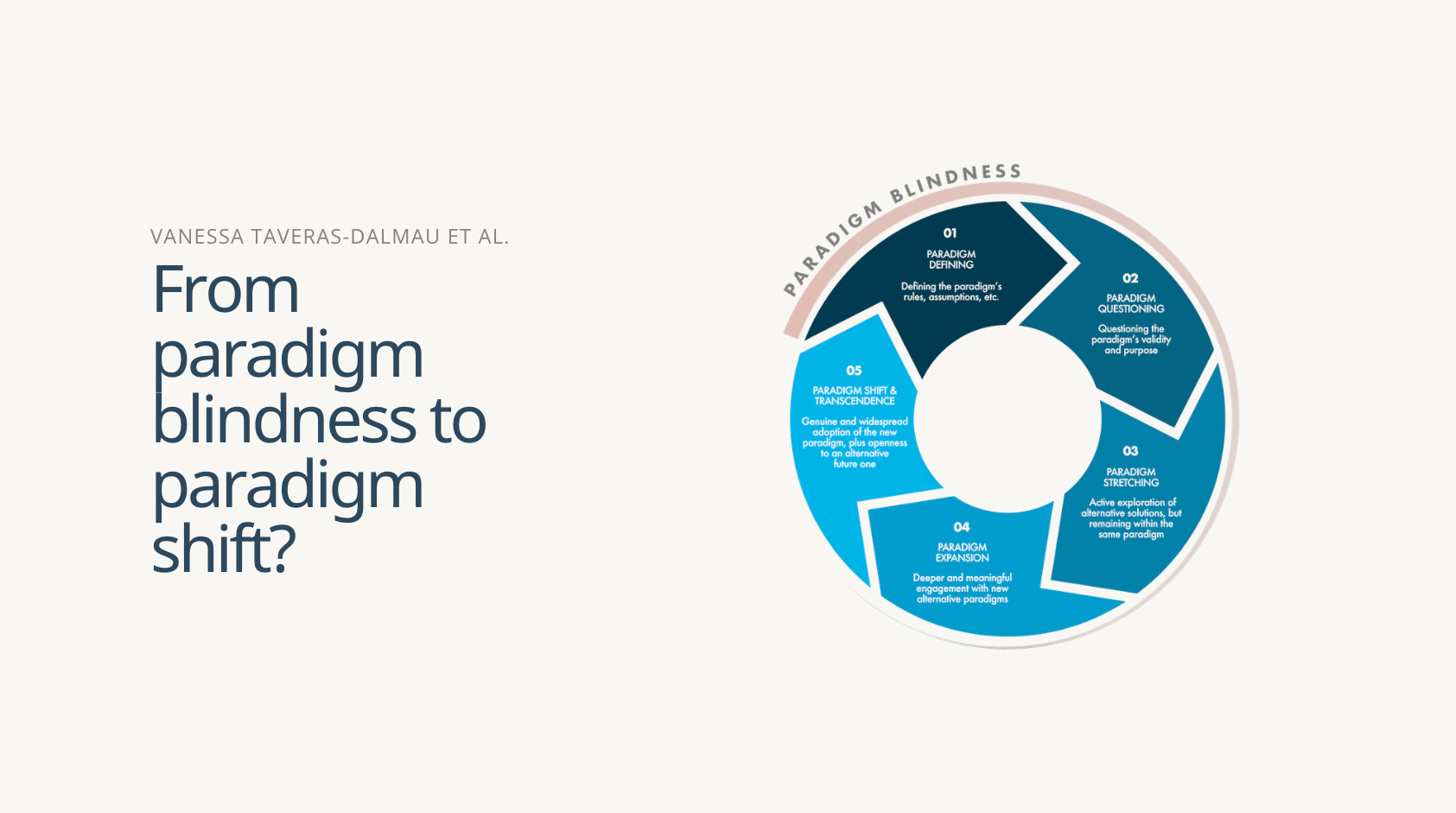
What gives me hope in their analysis and the story we heard yesterday is that regeneration doesn’t emerge despite failure—it appears because of it. Out of that exhaustion to preserve the familiar, new patterns emerge: movements centered on collaboration, local knowledge, and care for place. The authors’ Regenerative Paradigm Map captures this perfectly, showing us how ideas, practices, and values that evolve in the spaces collapse leave behind.
However, the authors also warn that regeneration can fall into the same trap as the ecosystems it seeks to replace. The moment it becomes ideology—when we stop questioning its limits—it loses its regenerative capacity. Renewal depends on staying open, adaptive, and willing to confront the discomfort of unmaking what no longer serves.
Katherine Skinner and The Red Queen’s Race
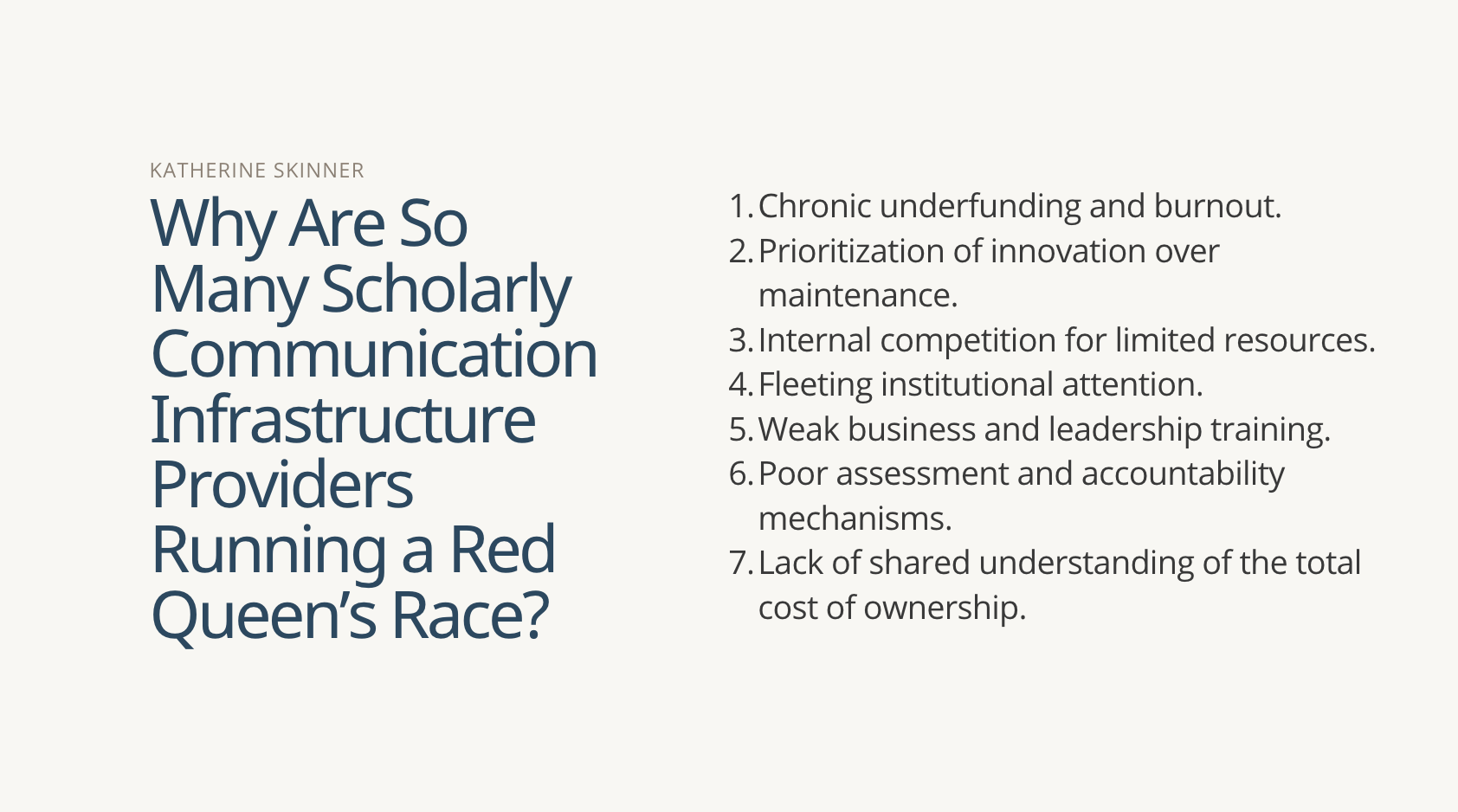
In Katherine Skinner’s “The Red Queen’s Race,” Skinner suggests what the ecosystem should look like for libraries. Skinner argues that academy-owned and academy-governed infrastructures for scholarly communication are trapped in an exhausting cycle of underfunding, fragmentation, and short-term survival strategies that prevent long-term sustainability. They are “running as fast as they can just to stay in place.” (a reference to Alice in Wonderland for those of you that might not be familiar). She identifies seven interlocking causes for this “Red Queen’s race”:
Chronic underfunding and burnout;
Prioritization of innovation over maintenance;
Internal competition for limited resources;
Fleeting institutional attention;
Weak business and leadership training;
Poor assessment and accountability mechanisms; and
A lack of shared understanding of the total cost of scholarly communication.
Together, these structural weaknesses create a cycle in which open, community-based initiatives must constantly reinvent themselves to remain visible and relevant, yet rarely achieve the financial or organizational stability needed for durability.
In The Red Queen’s Race, Skinner critiques the way academic culture rewards novelty over maintenance, leading to open infrastructure communities that continually chase new grants, features, or recognition rather than investing in the slow, collaborative labor of stability. This imbalance places immense pressure on the people and organizations responsible for maintenance. The absence of shared assessment, funding coordination, and leadership development further weakens these communities. What ultimately falters is not code or hardware, but trust, cooperation, and the social contracts that allow distributed actors to share responsibility for open infrastructure.
Finally, Skinner’s call for collective action situates resilience squarely within networks of relationships. She argues that the future of scholarly infrastructure depends on aligning communities, pooling resources, and establishing governance systems that reinforce mutual support. Her vision is to build interdependent communities capable of sustaining infrastructure through shared investment and stewardship. In this sense, the article strongly supports the idea that open infrastructure should be more than a single community; it should be an ecosystem of communities.
Conclusion
I know you’re probably expecting a story like the previous posts, but this time I’d like to ask you some questions, hoping that together we can create a new story.
How do we, as a community, encounter collapse?
Higher education, scholarly communication, and cultural heritage are undervalued in present-day society. We’ve been working tirelessly to convince the world that preserving truth, memory, and our collective cultural heritage is important. It’s almost humorous how many times I’ve had conversations with people who had this brilliant idea to preserve something or build some technology, only for me to point out to them that someone in libraries or museums has already done it.
So, what if we stopped? What if we changed the way we encounter one another and our profession? What if we tried something new? What if we started by designing our own ending? If we could tear down the organizations that we have built, what would we want to get rid of? How would we reimagine our profession and our organizations? By following the pattern of emergence and regeneration, could we encounter collapse not from a place of fear, but a place of excitement and anticipation? What would it mean to design endings that invite both encounter and renewal?
References
Skinner, Katherine. “Why Are So Many Scholarly Communication Infrastructure Providers Running a Red Queen’s Race?” Educopia, July 23, 2019. https://educopia.org/blog/why-are-so-many-scholarly-communication-infrastructure-providers-running-a-red-queens-race/.
Taveras-Dalmau, Vanessa, Susanne Becken, and Ross Westoby. “From Paradigm Blindness to Paradigm Shift? An Integrative Review and Critical Analysis of the Regenerative Paradigm.” Ambio, ahead of print, September 12, 2025. https://doi.org/10.1007/s13280-025-02232-7.
You can also watch my speech directly via YouTube: