
I'm Back...
In which I explain where I have been for the last month.

Life has been a bit hectic lately, which is why I’ve been MIA on Substack and LinkedIn for the past month. My friend says it’s because Mercury is in retrograde while being in Sagittarius. Now I only know what that means because of the memes she sends me on Instagram, but it seems like she might be right. Between dealing with a small flood, replacing old knob and tube wiring, and preparing for a nearly two-week trip to New Zealand, life seemed out of control.
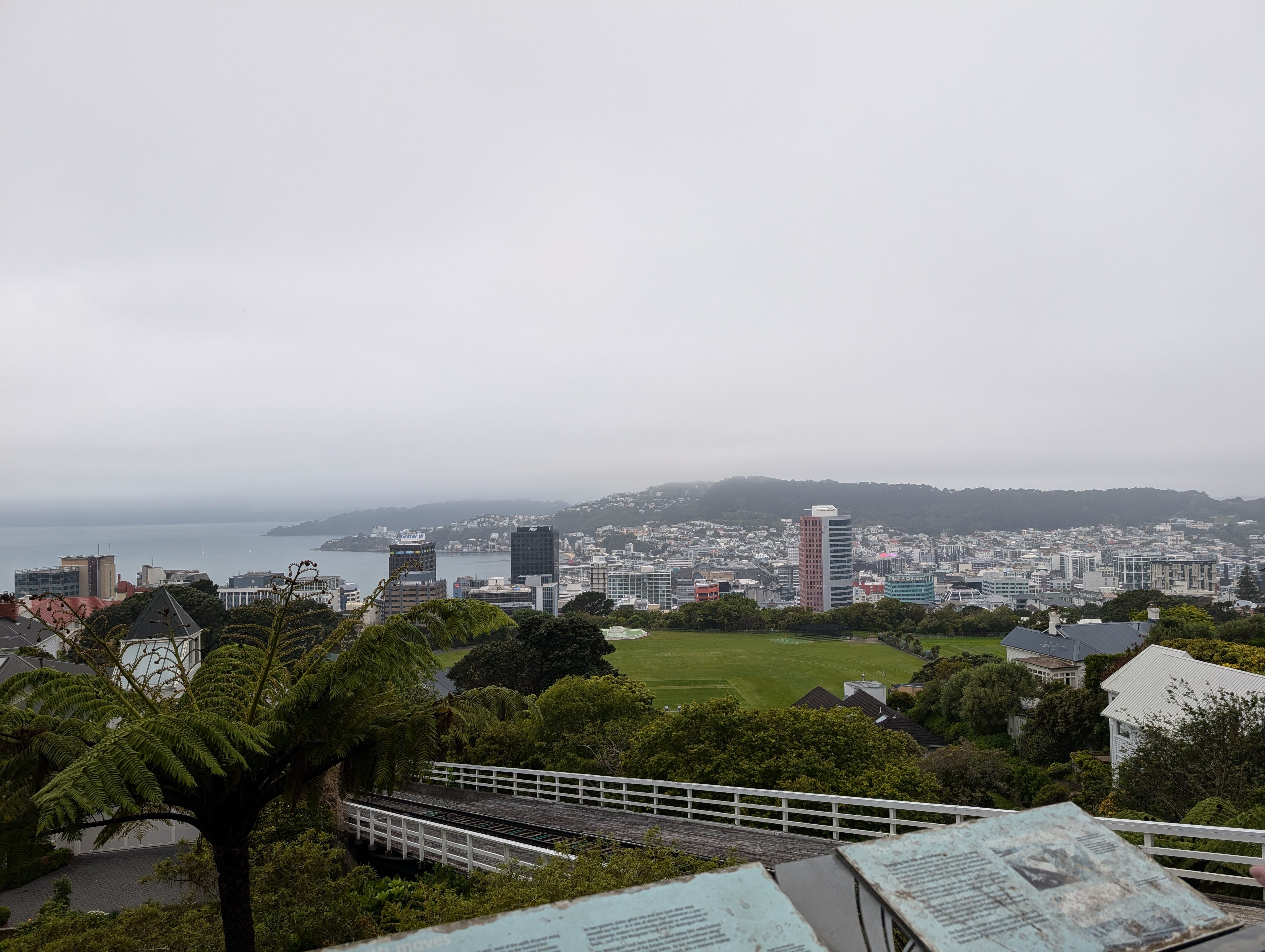
Oh, and yes! I went to New Zealand to speak at iPRES (the international digital preservation conference) in Wellington. What an experience that was! The same friend who pointed out that Mercury was in retrograde also said I time-traveled because of the trip. I left New Zealand at 2:30 PM on Wednesday and landed back in Atlanta at 3:30 PM on the same Wednesday, even though the trip took 20 hours. Basically, I experienced Wednesday twice, which is weird.
Now that I’m over the jet lag (and a little poorer, because of all that home repair), I’m excited to share my thoughts on the happenings over the last month and what I’ve been contemplating lately.
Contemplations on the Shift
There are a couple of topics I wish I could have shared or discussed over the past month.
The AI, Cultural Heritage, and Common Crawl
While preparing for my talk at iPRES, I realized that the ship has already sailed when it comes to thinking about what comes next for cultural heritage, education organizations, and AI. Major AI corporations have already acquired and monetized the digital collections and content for cultural heritage organizations. While we attempt to reshape the landscape, significant changes have already taken place, making that nearly impossible. To me, this suggests that our efforts to influence what’s next may be too late.
One slide in my presentation featured a video of how OpenAI is using my university’s collections.
In the video, you can see me prompting ChatGPT with a couple of questions about my university’s collections. OpenAI, via an incognito window, while I’m not logged in, provides me with a ton of information about the collections and even individual objects.
And by the way, most (if not all) libraries, galleries, and museums are available in LLMs like ChatGPT, CoPilot, Claude, and Gemini. If you’re unsure about any of this, ask one of these models what it knows about your library’s special collections or open access scholarship and see what it responds.
So how is it that all these LLMs have managed to get our content? Enter Common Crawl. If you haven’t heard of Common Crawl, it’s a non-profit organization that maintains a massive, open repository of web crawl data, which provides (for free) petabytes of internet content. This archive serves as a foundational dataset for training Large Language Models (LLMs) and conducting internet-wide research. A staff member at the Common Crawl has connections to the GLAM sector because Common Crawl uses a file format called WARCs.
The WARC specification was developed in 2008 and is generally recognized by libraries as THE standard for web archiving. It was created by John A. Kunze (formerly of the California Digital Library), Allan Arvidson (National Library of Sweden), Gordon Mohr (formerly of the Internet Archive), and Michael Stack (Internet Archive), and is based on the Arc File Format, which Mike Burner and Brewster Kahle developed at the Internet Archive. So basically, libraries developed it to archive the web, and Common Crawl uses it to crawl the internet. Makes sense, and that sounds great (in theory, but you know, communism is also great in theory; less so in practice).
The morning I was to give my talk, The Atlantic published an insightful article about Common Crawl and its connection to major AI companies. The story also points out that Common Crawl is now benefiting from major AI companies that are donating hundreds of thousands to the organization, presumably to ensure its continued work. But as far as I know, none of the companies (including Common Crawl) donate to the individuals who created the WARC standard, or the organizations that paid them to develop it, or even to ISO, which currently maintains the standard. I would love to hear that I’m wrong, though, so message me if you know otherwise.
I won’t even begin to describe how bad Common Crawl’s executive director, Rich Skrenta, comes across in the article; you don’t have to read very far in the above-linked article to see that for yourself. Oh, and if you want to see if Common Crawl crawls your site, all you need to do is search in its index for your site’s URL.
Of course, if you don’t want your content in LLMs, you could ask Common Crawl to remove your site from their crawls and their historic WARC files; however, the story also alludes to the fact that Common Crawl might be lying about taking content out of historic WARC files. Not a good look to say the least.
The Need for Nuance and New Models
This pervasive issue of content being monetized by parties other than the content creators creates the sense that we’ve lost control of our content. Ultimately, this has led to a fair amount of hostility toward certain vendors, particularly in the cultural heritage space, and the overall anti-corporate climate we live in. I’ll be honest, sometimes that climate can be a bit overwhelming. At the same time, I can’t say I blame folks, and I’m DEFINITELY NOT suggesting we should be pro-corporation. Maybe one day I’ll give you a list of the corporations I’ve stopped engaging with, but today is not that day.
However, I do think there’s a clear difference between the different types of corporations, their roles in an ecosystem, and the technology they produce. Over the last month or so, I’ve begun to disentangle how I see these various facets of technology corporations in particular. This is why I’ve been following OpenAI’s transition from a non-profit to a for-profit organization so closely.
If you haven’t been following this story, let me provide you with a brief recap. OpenAI was founded in 2015 as a non-profit research lab dedicated to developing safe artificial general intelligence. Since then, OpenAI has restructured its operations first by creating a for-profit subsidiary in 2019, which limited the amount of money investors could earn on their investment. In October of this year, OpenAI converted the for-profit subsidiary into a Public Benefit Corporation (OpenAI Group PBC) and the non-profit entity into the OpenAI Foundation. This latest transition enables the new PBC to raise unlimited investment while also requiring them to balance three things: stockholder interests, the best interests of those impacted by the company, and a specific public benefit (the pursuit of safe AGI). Most importantly, the non-profit entity retains control of and a significant stake in the company’s commercial pursuits, which is supposed to ensure it remains aligned with the non-profit’s mission.
I’ve been considering how this shift might also benefit the cultural heritage and education sectors. In our field, we tend to favor creating non-profit organizations, specifically 501(c)(3)s. We really do love them, and often dedicate decades to building and improving these organizations. Given the latest with OpenAI, I’ve been thinking about whether a similar approach could work for the non-profits we already have. I may explore this idea further as my thoughts evolve. Still, for now, it’s enough to suggest that many organizations could benefit from exploring what it would mean to become a public benefit corporation rather than a traditional non-profit. And why stop there? Perhaps society as a whole should also consider this shift. We, (society), don’t frequently question our legal structures or consider what they should look like or evolve into to fit the changing landscape.
These questions about shifting models and trust — trusting corporations, leaders, professions, and technology — were swirling in my mind as I flew to Wellington, New Zealand. The iPRES conference featured three powerful keynotes (or four, if you count mine) that forced me to re-examine these critical societal issues, particularly how they connect to the ways cultural heritage organizations preserve content, artifacts, and society. The conference offered an opportunity to delve into corporate trust, digital sovereignty, and the role of technology.
iPRES 2025 Recap
I was one of four keynote speakers at iPRES. What follows is a quick rundown of the main conference themes, a recap of all the keynote speakers, and my own takeaways from the conference.
Tuvalu: The Digital Nation
The first keynote speaker was Simon Kofe, the Minister for Transport, Energy, Communications, and Innovation for the Government of Tuvalu. If you don’t know anything about Tuvalu, they are a tiny Pacific island nation comprising nine low-lying atolls (a ring-shaped coral reef, island, or series of islets that encircles a central lagoon) that faces an existential threat from rising sea levels, which could render it uninhabitable within the coming decades. The atolls cover about 10 square miles and are on average about 2 m above sea level; their highest point is around 4.5-4.6 m, which is roughly 15 ft. This means that climate change is affecting the island nation in ways most people on the planet aren’t.
When Simon first described the situation, it prompted me to ask (in my head, of course) some crucial questions about the country’s existence.
What would happen if sea levels rise to the point where people can no longer live there?
If it’s submerged, will the space still be considered a sovereign land?
Will the people of Tuvalu still be considered citizens of Tuvalu if the land no longer exists?
These are the questions that Simon Kofe and the rest of the Tuvalu government are grappling with. In response to this climate crisis, the government has launched a “digital nation” initiative to constitutionally assert its statehood in perpetuity and create a virtual twin of the nation in order to preserve its history, culture, and sovereignty even if its physical territory is lost. They are also making sure their government is digital-first so that, as a nation, it can continue to exist long after the sea takes their land.
When you think about it, this is a mind-blowing concept to wrestle with. Most governments have always existed because of the land they “own”. What happens when your land is taken from you by the environment rather than a conqueror? Do you still exist?
Tuvalu has two things going for it that many other countries don’t.
First, they own all the .tv domains. So every time someone or something buys a .tv domain, they’re supporting the nation of Tuvalu. Sure, that may sound like a weird thing for me to bring up, but .tv domains generate millions of dollars for Tuvalu each year. So, friends, go out and buy the .tv domain and support Tuvalu!
The second thing they have going for them is their relationship with Australia. The Falepili Union, a landmark bilateral treaty signed in 2023 between Tuvalu and Australia, establishes the world’s first “climate mobility” framework. The agreement is a trade: in exchange for Australia gaining the right to veto Tuvalu’s security agreements with other nations, Tuvalu receives several benefits. These benefits include an annual special visa for 280 Tuvaluans to migrate to Australia and receive full rights within the country (thus avoiding the “climate refugee” status), a commitment from Australia to defend Tuvalu against military aggression, disasters, and pandemics, and Australia’s recognition of Tuvalu’s statehood and sovereignty indefinitely, even if the country’s land becomes fully submerged.
Simon’s talk raised fundamental questions for me: How do we keep a people’s culture, heritage, government, identity, and continuity alive in today’s world? The main hurdle isn’t just archiving photographs, maps, government documents, or other historical records; it’s about preserving the heart of a society even as it changes. Preservation has to move past just the physical and include digital memory, social connection, and the core principles that define who we are as a people. This means we need a big-picture view, recognizing that culture, history, mores, and politics aren’t separate things — they’re a tightly woven fabric we have to protect for future generations.
Migrating a Government in Crisis
During the conference dinner at The Beehive, the common name for the Executive wing of parliament, Liam Maxwell, the Director of International Central Government at Amazon Web Services, gave a short talk about his work with the Ukrainian government. AWS and the Ukrainian government worked together to migrate Ukraine’s infrastructure to the cloud around the time Russia launched its invasion of Ukraine. They completed that migration in just three months. Today, AWS hosts over 10 petabytes of data for various Ukrainian ministries, universities, and K-12 schools, as well as dozens of private-sector companies on behalf of Ukraine.
When you think about migrating anything, it usually takes much longer than three months. One bank actually migrated all its infrastructure to AWS in 43 days, which I find incredible. I can’t even get my organization to agree on what we’re doing in three months, let alone 43 days to migrate everything.
Liam’s talk was brief but impactful, touching on many of the themes Simon discussed. Once again, I found myself asking, what is essential? What are you trying to preserve, how are you trying to preserve it, and what is the most important part of what you want to keep?
Revitalizing Indigenous Language through Digital Sovereignty
Peter-Lucas Jones, a leader in Māori language revitalization, delivered the final keynote. Peter-Lucas doesn’t have a Wikipedia page, but he was named to the TIME100 in AI list for 2024.
If you’re not familiar with the Māori, they are the indigenous people of New Zealand with a language of the same name. Peter-Lucas discussed Indigenous Digital Sovereignty, which is defined as the exclusive right of Indigenous peoples to govern, manage, and control their own data and digital infrastructure. This idea might be new to many American readers, but digital sovereignty is actually a significant global discussion. Much of the conversation stems from concerns other countries have about the risks posed by US tech giants such as Google, Microsoft, Apple, and Amazon, as well as the general direction of the US government.
In addition to being a big advocate for Indigenous Digital Sovereignty, Peter-Lucas is developing several applications and tools to help preserve the Māori language for future generations. Listening to Peter-Lucas discuss his goals and watching a demo of his app, which automatically translates Māori into on-screen subtitles, was exciting. He confidently did a live demonstration, something I would never attempt in a million years, and I was amazed by what he and his team have accomplished.
What really stood out in Peter-Lucas’s talk was his genuine dedication to the values he talked about. As an Indigenous man, he wasn’t just talking the talk; he was actively working to preserve his language and build the technology to ensure it lives on forever.
My Own Keynote
The last talk I’ll recap for you is mine, and to be clear, I don’t have a Wikipedia page and I’ve never been named to a TIME 100 list. Yes, I too was wondering why me. But I digress. I’ll do a quick recap of my presentation, since I’ll likely post a more extended version in the coming week or so.
In my keynote, I explored the conference theme of Tūtaki (Encounter).
In the first section, I challenged the assumption that our technical systems are stable or neutral, arguing instead that they encode power and prioritize specific interests. Drawing on Hannah Arendt’s political philosophy about the erosion of truth, I talked about how our technical choices are, in fact, moral decisions that determine whose history is preserved and whose is excluded. I contend that we must stop viewing neutrality as a virtue and instead recognize that we are engineering relationships and trust when we preserve content.
Next, I explored the idea that community supports our ecosystems, arguing that the resilience of any system depends on the relationships that sustain it rather than on the technology itself. I applied Elinor Ostrom’s principles of governing the commons (I know you’re shocked) to show how shared governance and mutual responsibility are essential for managing open infrastructure rather than top-down control. And I illustrated all of this with the story of the Fedora Commons community’s recovery from the Fedora 4 migration crisis, demonstrating that true sustainability comes when we treat relationships as the primary system to maintain.
In the third section, I interrogated our profession’s devotion to openness, arguing that without governance, openness inevitably leads to exploitation. Drawing on Katherine Skinner and Nadia Asparouhova, I critique how “open by default” models often mask the extraction of unpaid labor and data by commercial entities, turning our democratization efforts into pipelines for corporate profit. Ultimately, I warn that openness without governance leads to exploitation.
Finally, I invited the audience to encounter “collapse” not as a failure but as a necessary threshold for renewal. Drawing on Margaret Wheatley’s work on emergence, I suggest that institutional or technological breakdown creates space for us to reorganize and rebuild ecosystems based on interdependence rather than control. The talk concluded by asking the community to intentionally design for these endings, using them as opportunities to regenerate a profession that is more resilient, connected, and aligned with our shared values.
My Takeaways
Throughout all of these talks, I began thinking about how the cultural heritage and higher education sectors need to confront the reality of collapse, because whether we like it or not, it’s coming. The core challenge is not how to respond to “what is next,” but to anticipate and plan for “what comes after next.” We must consider the actions and ideas necessary today to build a future that extends beyond tomorrow.
Engaging with this work requires an uncomfortable confrontation with the past—how we reached our current state—and a critical reflection on what we should have done differently. This self-assessment is vital, as it prepares us to undertake the necessary work to actively fight for the world we aspire to create.