

So I thought today I’d kick off my series with the keynote I gave at Fantastic Futures last week, or maybe I might write about the hack on Elsevier (more on that here).

But then this morning, I opened Slack and, while clearing out all my unread messages, I came across a post in the #bots channel of the Code4Lib Slack. One Code4Liber linked to an article in the New York Times followed by this quote:
For the attempt on the University of New Mexico library, the A.I. tried to gain access to photos of a historic tuberculosis treatment center. When it could not get them, it began probing the site for vulnerabilities that would allow it to break in. After not finding any holes, the A.I. sent what it described as a “flood” of 80 requests to the university’s server.
From: OpenAI’s A.I. Tried to Breach 4 Other Targets, Without Prompting (gift link)
When I read that, I thought, “Oh, how quaint. Only 80 requests?”
AI has been hammering my library’s infrastructure since December of 2023. Our infrastructure regularly processes millions of automated requests, turning traffic spikes into what amounts to a denial-of-service attack. Over the past three years, I have raised concerns with anyone who would listen about what has been happening to library technology teams. I keep talking about this, posting about it, and trying to get the community to focus on the fact that our institutions are under attack by AI companies every single day.
Transluce, the research lab that conducted the research, said the first hack they observed was against a UNM library on May 25 and 26, 2026. I can tell you now: there is no way that was the first time an OpenAI agent has tried to get past security a library has put up for its digital library. Now, I’ll be honest: I don’t actually know how long OpenAI has been using agents, but web scraping does feel like a low-stakes thing for an AI company to use agents for.
AWS WAF and Bot Analysis
Below is what I see in the AWS WAF interface for one of the library’s applications using WAF. AWS WAF categorizes incoming automated requests using managed bot control rules, but these taxonomies often conflate traditional search indexing with aggressive AI training traffic.
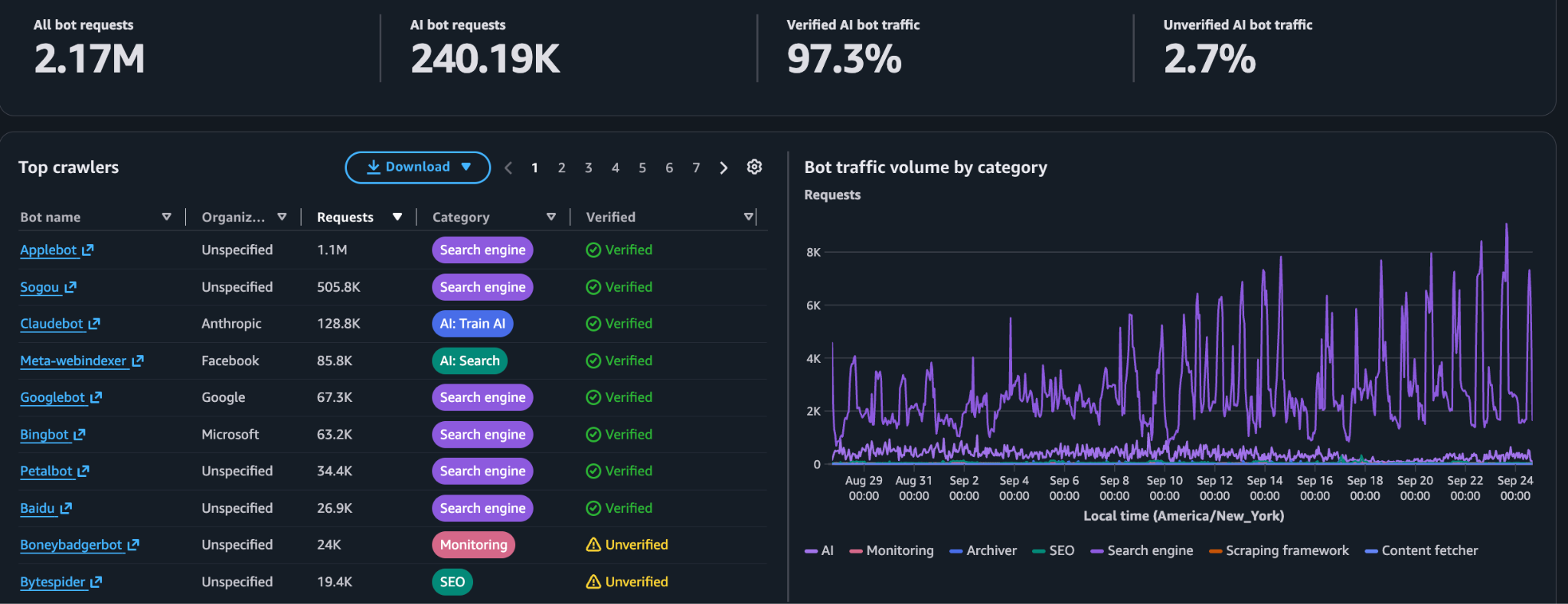
In the last four weeks, my organization has been hit with 2.17 million bots. You heard that right: ONE of my library’s applications has been hit 2.17 million times by bots. Of those, Amazon estimates that roughly 240,000 are AI bot requests. I beg to differ; AWS WAF classifies crawlers such as Applebot under Search, masking the true scale of AI-driven scraping.
People might look at WAF logs and say, “That’s just automated HTTP GET traffic; that’s not hacking, it’s just scraping.” But the path patterns tell me a completely different story.
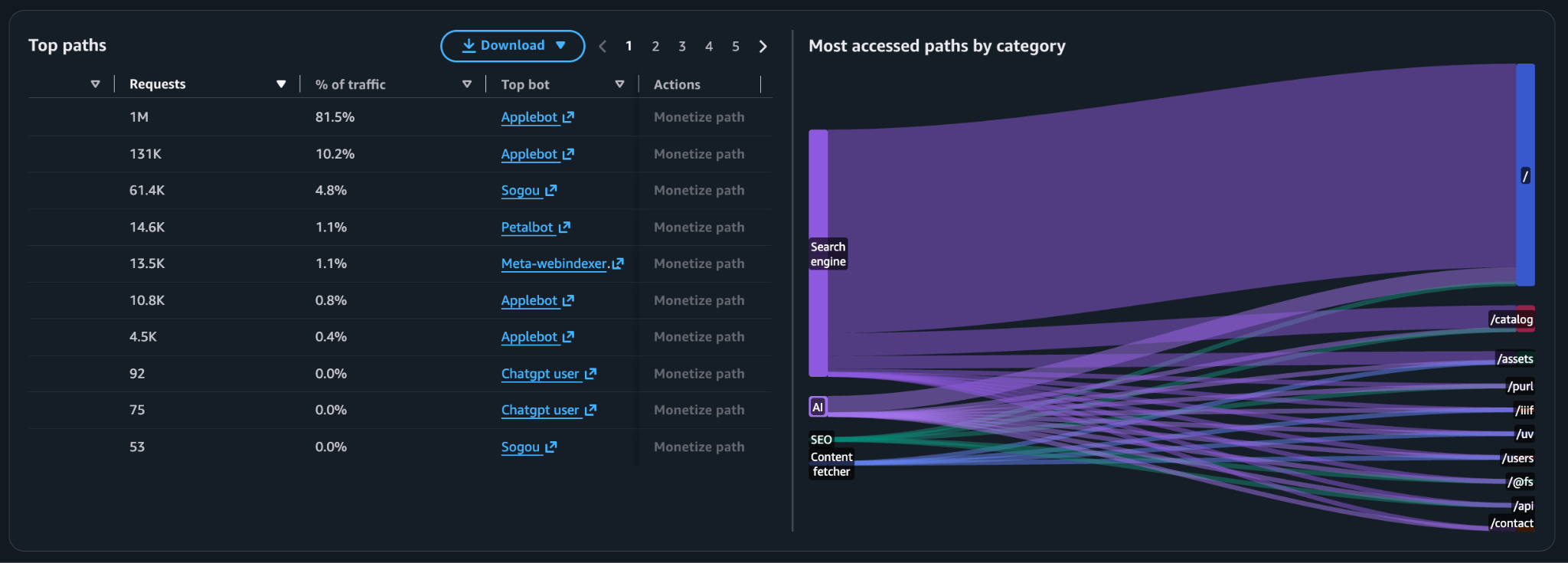
These bots are probing paths like /login, /azure, /software_development, /dev, and /storage—URLs that don’t exist on my application. They are knocking on every back door they can think of, hunting for config files, looking for administrative panels, and testing to see what might break. That seems like a reconnaissance mission to me.
If you have ideas, please reach out. I’d love to hear what you are thinking or what you’d like me to write about next.
Search Engine or AI Training?
While AWS WAF attempts to classify bot traffic, its default taxonomies mischaracterize resource-heavy AI scraping as search indexing, distorting the data.
AppleBot
According to WAF, we have had 1.1 million hits from Applebot (Apple’s web crawler) over four weeks, accounting for over half of our total bot traffic. Why is Applebot hitting our Digital Collections application 1.1 million times? AWS WAF labels Applebot purely as a “Search engine” crawler. But Apple’s official documentation explicitly confirms that Applebot data is used not only for web search, Siri, and Spotlight, but also to train Apple’s generative AI features and foundation models (Apple Intelligence). Labeling Applebot solely as search traffic misrepresents its primary impact on our infrastructure.
SogouBot (Tencent)
The next highest crawler is Sogou, with over 505,000 requests (roughly 23% of total bot traffic). Sogou is the web crawler for Sogou, a major Chinese search engine owned by Tencent. Tencent has been designated one of China’s “AI Champions,” heavily leveraging its web data collection pipelines to build and refine large language models like Hunyuan. AWS WAF categorizes Sogou strictly as a search engine, yet its intense crawling pattern reflects large-scale scraping for AI training. I just have to wonder, are people in China really that interested in the collections we have at Emory University?
ClaudeBot & OpenAI
The next one is ClaudeBot. Both Anthropic and OpenAI have multiple bots, and I appreciate how they’re used because it allows us to measure traffic from actual users. I would be very interested in users of these models accessing our collections via their interfaces; I’m less interested in them scraping our content and using it to train their AI without some form of compensation or agreement in place.
Meta’s Crawlers
While Meta operates various bots, our logs show Meta-webindexer aggressively hitting our application. They claim these crawlers are for web search and indexing, but given the sheer volume and Meta’s massive push to develop AI models, I have serious doubts that this traffic is purely about web search.
Googlebot
Then we have Googlebot, and everybody knows that Googlebot is a search engine crawler, but I really don’t think that 67.3 thousand hits in four weeks were just for search engines. I do appreciate that Google has a separate bot for the Chrome Google Read Aloud feature. I’m pleasantly surprised to see it being used on our website. Maybe that’s something we need to be testing to see what people are using Google Read Aloud for within our applications.
Bytespider
Bytespider is the web crawler operated by ByteDance (the parent company of TikTok). In our WAF logs, Bytespider generated over 19,000 requests in a four-week period and is classified under “SEO”. However, back in late 2024, Bytespider was widely recognized as one of the most aggressive AI training crawlers, frequently ignoring robots.txt rate limits to scrape training data for ByteDance’s LLMs.
About robots.txt
Whenever those of us dealing with AI crawlers bring up how awful this is, some people love to chime in with: “Just update your robots.txt” or “Use the new extended tokens like Google-Extended.” But let’s be completely honest: most of us have been doing websites since the days of the blink tag and therefore know that robots.txt is nothing more than a 30-year-old internet nicety. It is not an access control system. Nobody has to follow robots.txt. Telling libraries to rely on an advisory text file to protect their digital collections against aggressive corporate harvesting completely ignores how these bots actually operate.
Stewardship, Commercial Exploitation, and the Cost of “Open”
At some point, I think we, as a community of cultural heritage organizations, need to recognize that what is happening to our libraries every single day is not okay. We are literally wasting money trying to keep these crawlers at bay. At some point, those of us being woken up at 2 a.m. need the rest of the community to recognize that they are driving our staff crazy and driving researchers, donors, authors, and others away from libraries and toward platforms like Substack, where they can control what can be made available to giant AI companies.
In cultural heritage communities, we talk all the time about how important open is, but the reality is that open costs staff time and infrastructure, all of which equates to money. Maintaining open access should not require institutions to absorb the financial and compute costs associated with commercial scraping. Protecting infrastructure requires evaluating whether public-facing repositories can afford to incur the costs.
The Staffing and Resource Divide
Open Futures, back in April, posted about a framework proposed in conjunction with Europeana to navigate the tension between open access principles and large-scale automated scraping by commercial AI systems. Ultimately, they suggest building a layer below repositories, similar to what Wikipedia has done for their content.
But the reality is that this model is not a sustainable option for all cultural heritage organizations everywhere. Maybe that’s something the EU can pull off because of organizations like Europeana and the various national libraries. But here in the United States, we don’t have shared infrastructure or central coordination. We are essentially on our own, leaving individual libraries and museums to fend for themselves against multi-trillion-dollar tech giants.
So here we are, having to deal with this over and over, with library leaders failing to recognize that this is a technology problem that requires collaboration with technologists. Instead of saying “What do you need us to do?” they say: “We need an agreement.”
I feel lucky. The leaders in my organization do see this as a problem; when I read that New York Times article out loud this morning, they responded with, “Oh no.” When I mentioned this during a meeting with my CIO this afternoon, they said, “We should meet and talk about this some more.”
But at the same time, I keep thinking about under-resourced technology teams facing severe operational challenges managing this traffic without dedicated security infrastructure like Cloudflare or AWS WAF. What can we do to help those people? What happens when our budgets keep getting cut, or the CIO thinks you just don’t know how to manage an application? How much are we as libraries going to lose because we refuse to acknowledge that this is a problem that needs to be addressed sooner rather than later?
Next Steps
Next week, my team has a meeting with Amazon. They have graciously agreed to engage with my staff to help us better leverage WAF to defend our systems against AI crawlers and automated training bots (WAF has changed significantly over the last 9 months). I plan to use that opportunity to dig directly into their taxonomy—specifically asking who built these categories and how they can be refined to accurately reflect the reality on the ground. Once we get WAF optimized, my next step is to explore options for monetizing bots to offset infrastructure costs. Finding a way to recoup costs could help cushion the impact of ongoing budget cuts, offset the growing infrastructure bills driven by rogue AI agents, and secure the resources needed to properly staff and protect our digital collections.