
The Forcing Function
Part 2 of a 6 Part Series on Defining Open with Thoughtfulness in the Age of AI

This is the second post in a series based directly on my keynote at the EBSCO User Group Meeting in Omaha, Nebraska, where I’m exploring what it means to reclaim information sovereignty by defining “open” through the lens of AI. Just as I did for my WOLFcon Plenary and iPres Keynote, I want to bring the substance of that talk into written form so that the conversation can continue -- and also, I had to cut a TON of content from the talk that I think is very relevant to the conversation as a whole. You can explore the rest of the series here:
Part 2: The Forcing Function
Part 3: The Ideological Storm
Part 4: A Shared Reality
Part 5: Governance and the Commons
Part 6: Reclaiming our Seat at the Table
For the last few months, my neighborhood email list has been a hotbed of misinformation (I know, you’re shocked). I have watched people get caught up in narratives that simply didn’t align with the data, history, or reality.
So let me tell you a little story about our school district. My husband is the CIO for our K-12 school district, and we’ve talked over the years about the decline in school enrollment. This is something that I knew about, but being in higher education, I had time before this REALLY started hitting us, my husband less so.
Recently, the news broke that a school MIGHT POTENTIALLY close in my city. The community reacted with the usual drama: yard signs, accusations of mismanagement, and questions about how the school district arrived at the data it supplied. As I watched this unfold from the dinner table, I realized the real tragedy was that people weren’t lifting their heads up from their personalized bubbles. They were fighting over what was changing because they couldn’t see the collective reality.
So what is our collective reality? Let’s start with the “Demographic Cliff.”
In his 2018 book, Demographics and the Demand for Higher Education, Nathan Grawe describes the “Demographic Cliff.” In it, he projects a 15% decline in college-going students between 2025 and 2029 (so like right now).
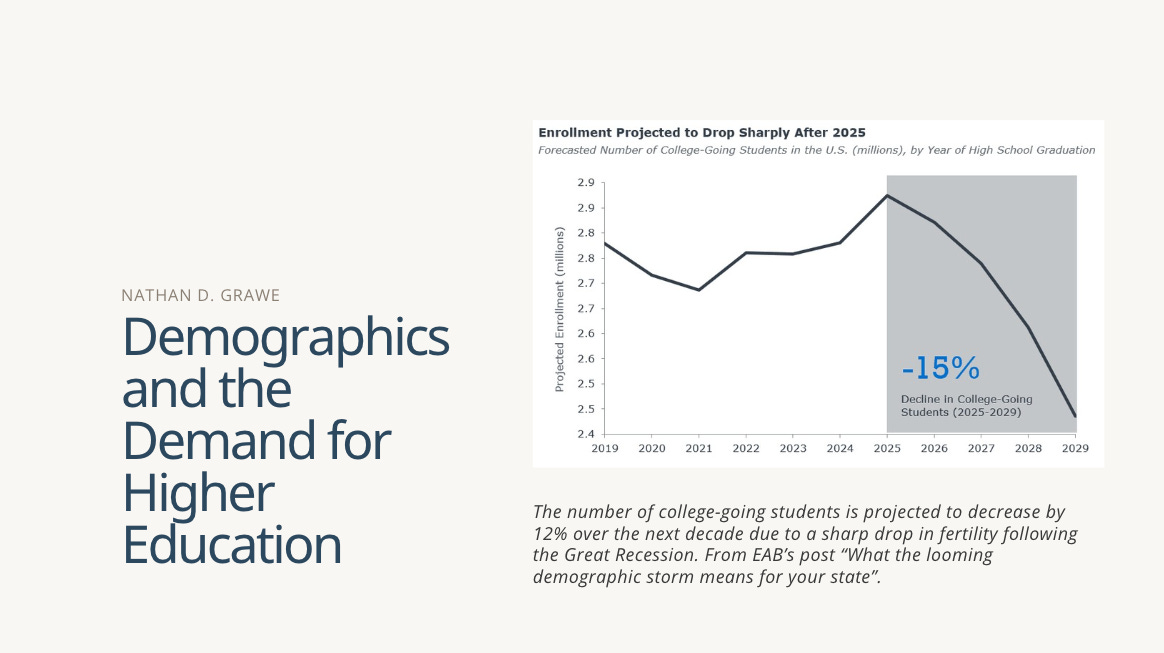
The convergence of the 2008 Great Recession and the subsequent global pandemic led to a substantial drop in college enrollment that exceeded what Nathan Grawe had foreshadowed in his 2018 research. Despite some recovery in recent years, the growth of traditional bachelor’s degrees is currently being outpaced by the rise in associate degrees and undergraduate certificates (see: Final Fall Enrollment Trends January 2026).
We are quite literally running out of students. My initial reaction to the neighborhood drama was pure indignation. I kept thinking: “How could they be so oblivious? Don’t they follow the news? NPR has an entire series dedicated to the population decline!”
And then I decided to join a class called “Decatur 101” because I thought, “I’m going to be the one to solve misinformation in my city.” (This is the point where you laugh at me because how ridiculous am I?). The class is designed to provide participants with information about the government’s inner workings. In each class session, we engaged with various city departments, listening to presentations about their operations and the challenges they faced.
During Q&A sessions—which often allowed for individual dialogue with city employees—I made a point of asking the same question: “What is the single greatest challenge your department is currently facing?” Most responses were predictably narrow: Parks and Rec lamented a lack of public understanding regarding their specific scope, while Planning cited confusion over local ordinances. Yet, as I processed these localized grievances, a pattern emerged: nearly every department was being blindsided by misinformation without even recognizing it by name.
Did this post spark an idea for you?
It became clear that the government was failing to communicate the collective context effectively. This was the same breakdown I saw on my neighborhood listserv: a fundamental disconnect in which people couldn’t see that the city’s struggles were often symptomatic of regional shifts or global pressures far beyond the four square miles in which we live.
What I realized was that my neighbors and the city weren’t just being difficult (I mean, some were; don’t get me wrong). They were drowning in a world they lacked the tools to navigate. Ultimately, we are all living in a world with a fundamental breakdown in communication that is preventing us from collecting, processing, and sharing the very knowledge our collective reality requires to maintain society and democracy as we know them.
And then, one Monday morning, I walked into a surprise meeting that was put on my calendar the Friday before. In that meeting, the University Librarian announced her retirement. And then two weeks later, one of my most knowledgeable staff members gave notice of her retirement. Next month? Our library and museum’s Chief Business Officer will retire. And two days before him? One of my go-to counterparts in our Office of Information Technology. By the time these retirements are said and done, collectively these four individuals will walk out the door with over a century of institutional knowledge, leaving us to navigate the gaps they leave behind.
The most daunting realization is that there is no “new generation” waiting in the wings to occupy all of the vacant chairs.
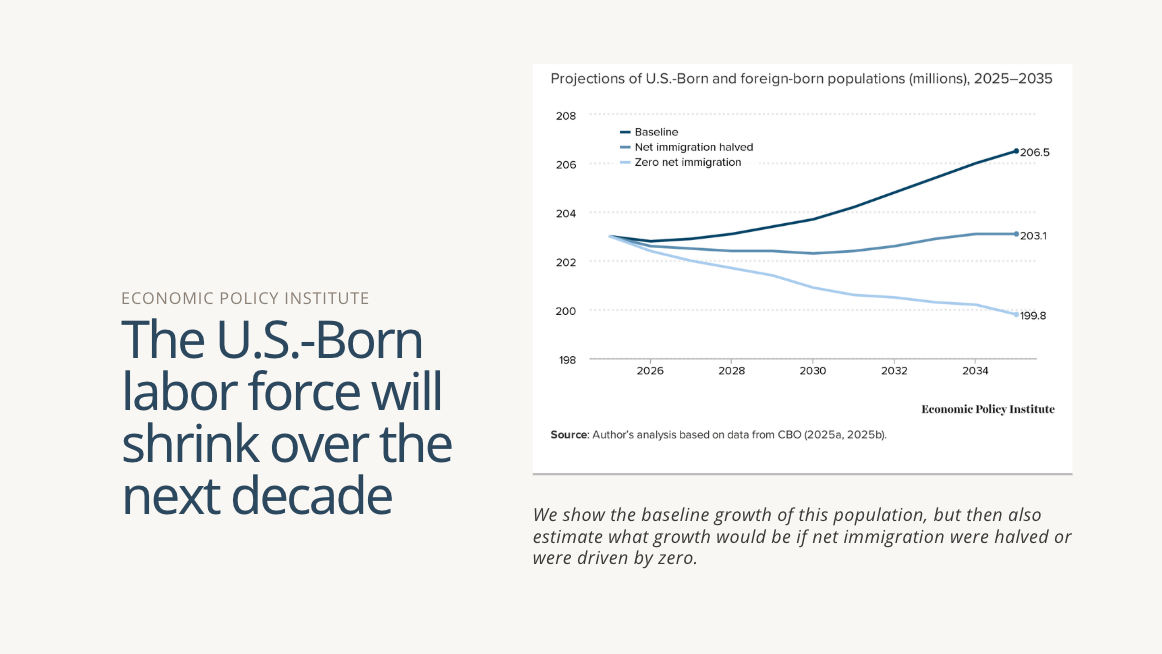
This data from the Economic Policy Institute underscores the reality that our U.S.-born labor force is actively shrinking. Recent projections from the Indeed Hiring Lab show that the U.S. labor force will shrink by 5.9 million workers by 2032. And the sectors getting hit the hardest? Education, healthcare, and government, where retirement rates are already projected to exceed 3%, far outpacing the influx of new talent. When viewed in its entirety, the data paints a daunting picture of the decade ahead.
First, the pipeline of incoming talent is drying up. The steady decline in student enrollment means fewer professionals are being trained to replace those we lose. Second, we are facing an unprecedented exodus of deep institutional knowledge as the number of retirements increases. Finally, the sectors that are deeply human, sectors like education, government, and healthcare, are exactly the ones where humans are most in demand. We face a mismatch: work is growing while the workforce is shrinking.
When viewed through this lens, AI ceases to be a threat to our professional existence and becomes, instead, a lifeboat. But here is the thing about a lifeboat: it prevents you from drowning, but it cannot construct a shore for you to land on. To survive this demographic storm, we must become the architects of the shore that we want to land on. This is the ultimate forcing function.
If you have ideas, please reach out. I’d love to hear what you are thinking or what you’d like me to write about next.
And if you don’t know what a forcing function is, that’s ok because I love a definition. The term actually has an interesting history. It was born in mathematics, specifically in the study of differential equations. There, a forcing function is a function that depends only on time, not on any other variables (thank you, Wikipedia). The term further evolved from Poka-yoke, a Japanese term developed by Shigeo Shingo at Toyota in the 1960s. It vaguely means “idiot proofing”. Decades later, in the late 1980s, cognitive scientist Don Norman used the term forcing function in his book The Design of Everyday Things. There, he used it to mean a strict physical or behavioral constraint that prevents you from continuing down the wrong path. So, as an example, I’m about to microwave a potato for dinner, and I can’t turn on the microwave without closing the door. That is a forcing function. (Again, thank you, Wikipedia, for a great example. Also, my baked potato was delicious.)
The demographic cliff and the silver tsunami are our forcing function. Time is disrupting our equilibrium. We cannot stop the wave of retirements, and we cannot instantly materialize a new generation of workers. At the same time, we have a strict constraint that prevents us from continuing to rely on an endless stream of new hires to sustain our institutions.
The “old way” has been rendered impossible. We have to design the shore of our new world around this forcing function. I know many believe AI is just another platform that technology companies are innovating for the sake of progress (or more accurately, the sake of money), but we are being compelled to adopt these new technologies and rethink our operations. We, the people being impacted by this forcing function, must innovate as an act of survival.
I know I didn’t leave you on a joyful and uplifting note, again. But hopefully, you’ll stick with me; I promise we’re going somewhere good and positive. Next week we’ll (quickly) revisit some topics I’ve already talked about at length — the philosophy of big tech companies, how AI works, and what bot scraping looks like — before getting into new developments in this area that I think we should be keeping an eye on.
Most importantly, thanks for reading The Digital Shift! Subscribe for free to receive new posts and support my work.